

United States
SpaceTechCareers
A specialist job board for satellite, launch & space systems roles.
- Coverage
- United States
- Focus
- Aerospace
- Work setting
- Not specified
Introducing SpaceTechCareers
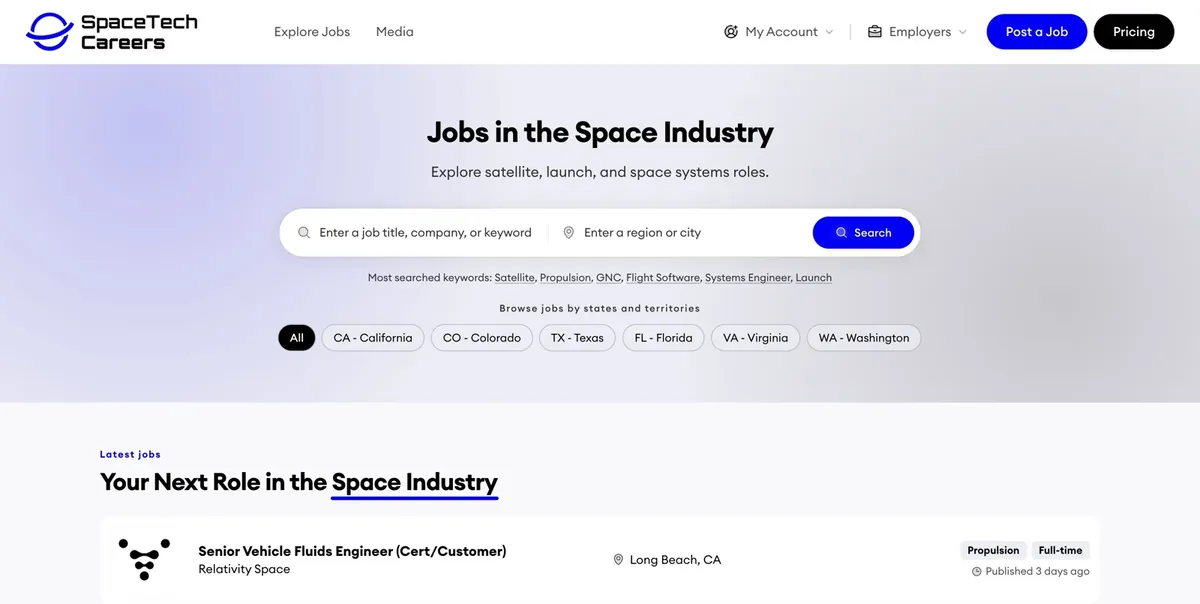
Plenty of aerospace boards mix airliner maintenance with rocket engineering. SpaceTechCareers does not: commercial aircraft work is explicitly out of scope. The board is limited to satellite, launch vehicle and space systems jobs in the United States.
Rolework, a Paris company that builds specialist recruitment sites, added it to its network in 2025. Listings cover spacecraft engineering positions, propulsion, GNC, flight software, mission operations and spacecraft manufacturing.
Browsing by job family and mission segment
The first layer is seven categories, all with landing pages: Space Systems, Propulsion, Avionics, Flight Software, a guidance category for GNC work, Mission Operations, and Spacecraft Manufacturing.
A second set of pages groups jobs by mission segment: satellites, launch vehicles, space infrastructure, Earth observation, space exploration and ground systems. Employment type and experience level filters narrow things further. Search is US-only, and the homepage links straight to California, Colorado, Texas, Florida, Virginia and Washington, the states it highlights.
The space workforce it targets
Candidates are spacecraft and propulsion engineers, flight software developers, GNC specialists, integration and test staff, and mission or ground system operators. Manufacturing, avionics and data roles count when they are tied to space systems or missions.
Excluded: commercial aircraft-only roles, generic software, unrelated electronics and science jobs without real satellite, launch or space systems duties. The board also separates space technology from astronomy education. The geography is fixed: a job has to be in the US or serve US operations.
SpaceTechCareers pricing
Searching and applying are free. Employers buy posting credits, each running one listing for 60 days. As of late 2026, each credit is $469 USD before tax. Five credits cost $1,993, thirty cost $9,849, and a 100-credit pack costs $23,450, putting each job at $234.50. Payment is in US dollars.
Credits never run out. For primes and launch companies with a long list of open roles, Automated Job Posting comes as yearly plans on the pricing page. Their price depends on the number of jobs live at the same time, and the number posted over the year has no limit.
What space engineers get from SpaceTechCareers
If you have spent years on a satellite bus or a launch vehicle, a general aerospace search buries your options under aircraft roles. Here, mission segment pages let you follow Earth observation or launch work specifically.
Alerts, a candidate profile and saved jobs are free. You apply through the employer's own process.
What space companies get from a post
Space startups and primes chase the same small group of propulsion and GNC engineers. A board that only shows space work reaches people who already chose this sector. A GNC or propulsion listing gets a company profile, goes to candidates with matching alerts, can be shown in Google for Jobs, and reports views and Apply clicks.
Logos of Lockheed Martin, Rocket Lab, Firefly Aerospace, Planet Labs and Varda Space Industries appear on the homepage. Our aerospace job boards page lists further options.
Built-in tools for space hiring
- A replacement credit when a listing ends its 60 days with no more than four Apply clicks.
- Automated Job Posting, which refreshes jobs out of an ATS, careers page or feed at least every 48 hours.
- Mission segment landing pages alongside the usual job category pages.
Where SpaceTechCareers fits
The strict space-only rule is the board's best asset. It keeps aircraft and generic engineering noise out, which candidates will appreciate. Price is on the high side for a 2025 launch that is still growing its listings, so smaller teams may want to test a single post before buying a pack.
Best for US launch providers, satellite makers and ground segment teams. Rolework, the owner of SpaceTechCareers, also publishes this directory. Technicians who work on aircraft electronics should look at AvionicsTalent.