

Global
OceanScienceJobs
A specialist job board for oceanography, marine biology & ocean conservation roles.
- Coverage
- Global
- Focus
- Science
- Work setting
- Not specified
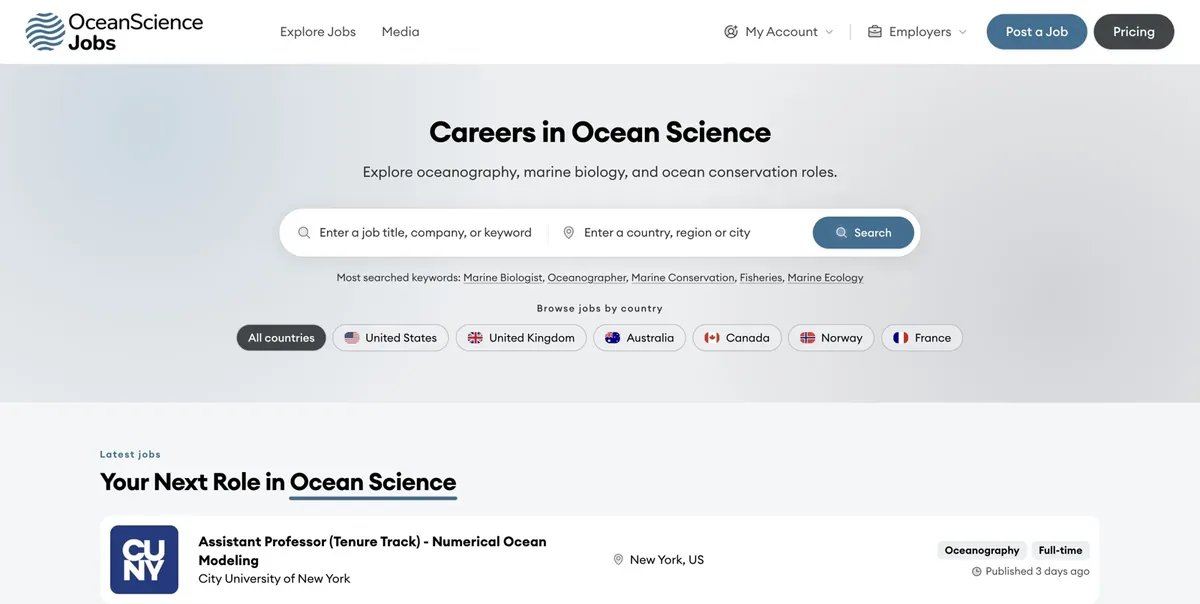
OceanScienceJobs: research careers at sea and ashore
Fellowships, internships and contract research posts are the usual entry points into ocean science, and they are often advertised on university HR pages, institute sites and mailing lists. OceanScienceJobs collects them alongside permanent positions on a single international board for oceanography, marine biology and ocean conservation.
The site has existed since 2025 and is run by Rolework, a recruitment company in Paris. It works as a job board for marine biologists and oceanographers, open to search without an account.
Research focus and education filters
Seven categories structure the board, each with its own page: Oceanography, Marine Biology, Marine Ecology, Marine Conservation, Fisheries Science, Ocean Data Science and Marine Research Support.
The filters are adapted to academic and applied research. A research focus filter separates physical, biological and chemical oceanography, marine geology, coastal science and marine policy. A minimum education filter runs through vocational qualifications, associate, bachelor's and master's degrees, PhD and professional doctorate, with an option for equivalent experience. Employment type includes internships and fellowships, which most generalist boards ignore.
Scientists, technicians and conservation staff
The site speaks to oceanographers, marine biologists and ecologists, fisheries scientists, ocean data scientists and research support staff. On the hiring side, it is aimed at government research agencies, institutes, universities and conservation NGOs.
Fieldwork, data science and research support qualify when the science concerns oceans or marine life. Applied conservation science is included. Marine tourism and ordinary vessel operations are not. There is no geographic limit, and remote roles count when the work fits.
OceanScienceJobs posting costs
Candidates pay nothing. Employers buy credits, each giving one listing 49 days online. As of November 2026, one credit costs $199 plus tax. A three-pack costs $537, ten credits $1,592 and 100 credits $9,950, half the single price per job. European institutes can pay in euros instead of dollars, and unused credits stay on the account.
A postdoc or technician vacancy that collects under five Apply clicks earns a new credit. Research institutes that advertise all year can subscribe annually to Automated Job Posting. Its tiers, on the pricing page, cap how many jobs are live together but not how many are posted in a year.
Why early-career marine scientists should look
The education filter is the practical win. A graduate with a bachelor's degree can skip PhD-only postdocs, and a technician can find roles that accept equivalent experience. The research focus filter keeps a chemical oceanographer from scrolling through coral reef monitoring jobs, and the reverse.
A researcher can save postings, keep a profile and set alerts without paying, and applies through the institute's own site or by email.
Recruiting researchers on OceanScienceJobs
Research employers often struggle to reach candidates outside their own networks. A post here reaches a self-selected scientific audience. It also gets an institution profile, can be shown in Google for Jobs, is emailed to scientists whose alerts fit, and reports Apply clicks, views and unique visitors.
The homepage carries logos of NOAA, CSIRO, Woods Hole Oceanographic Institution, Ifremer and Ocean Conservancy.
Built around academic hiring
Fellowship as a job type, the education filter and the research focus filter all reflect how science careers really progress. The 49-day posting period is shorter than the 60 days offered by OceanTechJobs or SubseaCareers, so time a post to the application deadline. Automated Job Posting can mirror an institute's ATS or careers page, syncing at least every 48 hours. The site also has an FAQ for researchers, another for employers, and an Our Network page. Marine engineers may prefer the sister site OceanTechJobs for marine robotics roles.
Our view of OceanScienceJobs
OceanScienceJobs is a clean, well-scoped board for a field where job information is scattered. The filters are its strongest point, and the price is low for an international specialist site. Its weakness is youth: it launched in 2025, so listings are still accumulating, and established academic job sites will remain essential for now.
It works best for marine research institutes and NGOs posting internationally, and for graduates mapping their first research role. Rolework owns this board as well as jobboardfinder.com, so weigh our opinion accordingly. More options are in our science job board directory.