

Canada
Job Bank Canada
Canada’s public job board, with direct employer postings, nationwide vacancies, and resources for newcomers.
- Coverage
- Canada
- Focus
- General Job Boards
- Work setting
- Not specified
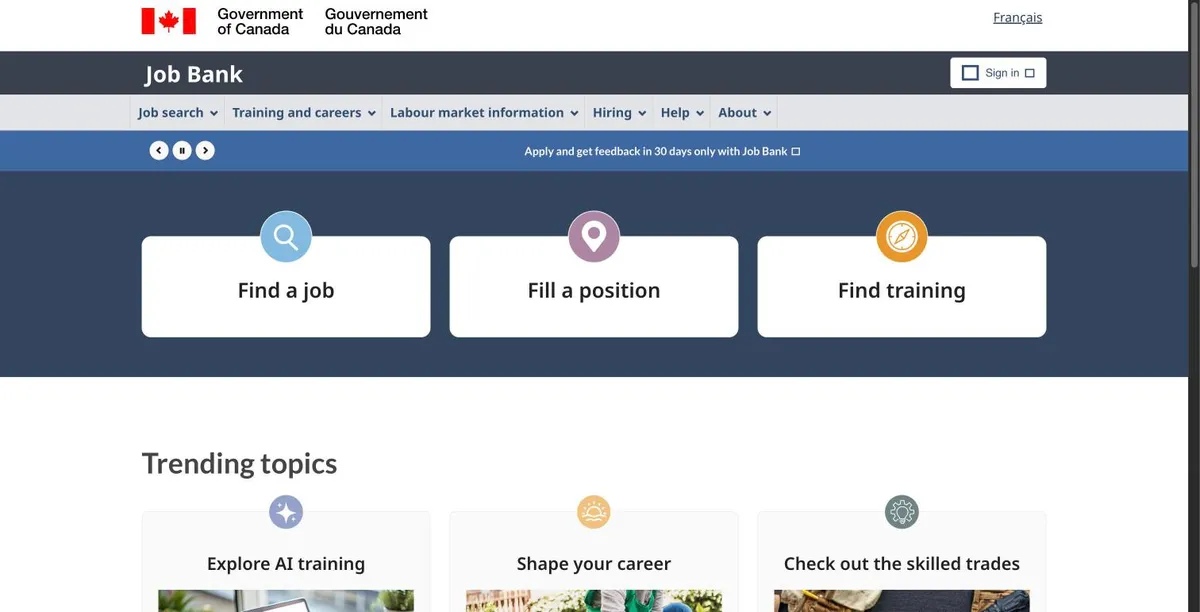
Job Bank Canada and a public service that dates back to 1918
Few job boards can trace their roots to the end of the First World War. Job Bank can. Its own history page starts in 1918, when Ottawa passed a law to set up local employment offices for returning soldiers. Those offices became a national employment service in 1940. In 1980 the National Job Bank database went onto public computer terminals, and in 1996 it moved online. A modernized site with job matching followed in 2014, and a mobile app in 2018.
Today Job Bank is Canada's national employment service. Employment and Social Development Canada (ESDC) runs it on behalf of the Canada Employment Insurance Commission, working with the provinces and territories. It is fully bilingual in English and French.
How Job Bank Canada structures its search
Search works by job title or keyword and by location, down to small towns such as Cobden, Ontario or Yorkton, Saskatchewan. Results are sorted by best match or date. Each posting shows the hourly or annual wage, the work setting (on site, hybrid or remote), the job number and labels such as Direct Apply or Posted on Job Bank, which flags ads placed directly by the employer rather than pulled in from partner sites.
Job titles follow the National Occupational Classification (NOC), which is why you see precise wording like "housekeeper (except private households)" or "child care provider - private home". Dedicated pages serve young Canadians, Indigenous people, newcomers, persons with disabilities and veterans.
Who relies on Job Bank Canada
Everyone, in principle, since it covers every province and territory and both official languages. In practice the board is strong in hourly and mid-skilled roles: food service supervisors, cooks, butchers, cleaners, caregivers, truck drivers and trades. Employers include franchise owners, small family businesses, private households hiring caregivers, and public bodies. Newcomers and temporary residents are heavy users, because Job Bank is the reference board in Canadian immigration processes.
Job Bank costs nothing on either side
Job Bank is free. Job seekers search, save jobs and apply at no charge, and employers advertise vacancies for free once they register an account and an employer file. There is no paid tier, no upgrade and no featured placement, which is one of its key differences with commercial boards. This was still the case in November 2026.
Why Canadian job seekers should use Job Bank
Every listing shows the wage, which takes the guesswork out of applying. A free Job Bank Plus account lets you apply in one click, get matched with employers and save searches. One rare feature: with Plus, you get feedback on your application within 30 days, telling you whether it was retained or the job was filled. Beyond listings, the site offers wage comparisons, job outlooks by occupation and region, career quizzes and a training search. Start a nationwide Canadian job search there before paying for any premium service elsewhere.
Why employers post on Job Bank
Cost and reach. A free Job Bank ad is shared through a partner network that includes Indeed, LinkedIn, Google, ZipRecruiter, Talent.com, Jobillico, Jobboom, CareerBeacon and several niche boards. Job Bank also returns a list of matching candidates whom employers can invite to apply. The Available Workers Dashboard shows how many people are seeking a given occupation locally or nationally. And for employers hiring foreign workers through a Labour Market Impact Assessment, advertising on Job Bank is generally part of the required recruitment.
Labour market data and other Job Bank tools
Job Bank doubles as Canada's public source of labour market information. You can compare wages by occupation and region, check job prospects and read trend analyses. Organizations can host Job Bank widgets or take an XML feed of postings. Employers in the Workforce Retention and Retraining Program can find training resources, and job seekers can browse courses, including AI training.
Job Bank Canada in our view
Job Bank is a public service done reasonably well. It is free, bilingual, transparent on wages and woven into Canada's immigration and employment programs. For employers it is an easy, zero-cost first step, and for candidates it is a reliable baseline. Its limits: the interface is functional rather than slick, professional and executive roles are better covered by commercial boards, and listings lean toward hourly work. It suits newcomers, entry and mid-level workers and any employer with an LMIA in progress. See more job boards in Canada and our expatriation job sites.