

Spain
InfoJobs Spain
Job vacancies across Spain, with searches by occupation, province, and employer, plus candidate profiles and application tracking.
- Coverage
- Spain
- Focus
- General Job Boards
- Work setting
- Varies by listing
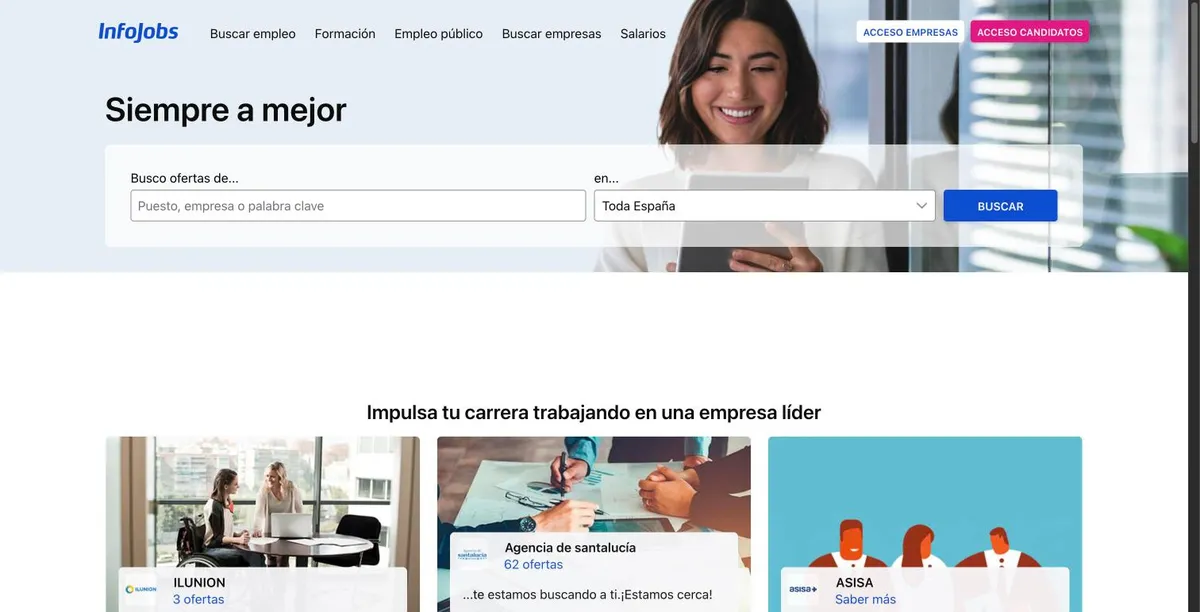
InfoJobs, Spain's job portal since 1998, under new owners
InfoJobs started in Barcelona in 1998 and spent most of the following decades inside the Schibsted group, then its classifieds spin-off Adevinta. In July 2025 the Swedish investment firm EQT agreed to buy Adevinta's Spanish businesses, which bundle InfoJobs with Fotocasa, Habitaclia, Milanuncios and coches.net, in a deal reported at around €2 billion. EQT now lists InfoJobs in its portfolio with a 2026 entry date. For Spanish candidates the name is close to generic: it is usually the first place people check for jobs in Spain, whatever the sector or level.
How InfoJobs organizes Spanish job offers
The search form pairs a keyword with a province, all of Spain or "abroad". Results can be narrowed by date posted, province, on-site, hybrid or remote work, and job category. Categories use everyday Spanish labels, such as Comercial y ventas, Profesiones, artes y oficios, Ingenieros y técnicos, Compras, logística y almacén, Sanidad y salud and Turismo y restauración. The homepage also offers shortcuts for jobs paying €35,000 or more, part-time work, remote work, management roles and jobs close to home.
A separate public employment section collects civil service and public sector openings, which are a big draw in Spain.
Who searches and recruits on InfoJobs
Almost every profile in the Spanish labor market uses InfoJobs: students, tradespeople, sales staff, nurses, engineers and executives. Madrid and Barcelona carry the largest share of listings, followed by Valencia, Zaragoza, Málaga and Seville, but every province is covered, including Ceuta and Melilla. Employers range widely, with temp agencies, retailers, hospitals and SMEs all active. A small number of listings come from neighboring countries and further afield.
What InfoJobs costs Spanish employers
Candidates use InfoJobs for free. Employers buy either pay-per-listing products or subscription packages sized to their hiring volume, with options for employer branding, CV database access and applicant tracking. InfoJobs does not publish a public price list; companies request a quote through the business area. We could not confirm current prices in November 2026.
Why Spanish candidates keep an InfoJobs profile
Scale is the obvious reason: one profile and CV reach a large share of the formal job market. InfoJobs also shows where each application stands, which many candidates value after sending dozens of CVs. Salary pages by occupation help with negotiation, and the company search shows who is hiring. Training courses through InfoJobs Academy round it out. Anyone looking for ofertas de empleo across all Spanish provinces can save searches as email alerts or use the mobile app.
When posting on InfoJobs pays off
For volume hiring in Spain, InfoJobs is a standard first channel. Applicants already know its process, and recruiters can filter applicants inside the platform or connect partner tools such as ePreselec. Companies hiring for public-facing brands can add employer branding pages. For niche technical profiles, a specialist board may still bring better targeting.
Things only InfoJobs does
- Application status tracking for candidates.
- A public employment section for civil service openings.
- InfoJobs Academy for job-related courses.
- Salary data by occupation.
- Job Market Insights and the yearly InfoJobs-Esade labor market report.
InfoJobs: our assessment
InfoJobs remains the reference job board in Spain, with a clear structure and features that respect candidates' time. Its weak spots are opaque employer pricing and the noise that comes with sheer volume, especially in sales and temp roles. The change of owner is worth watching but has not altered the product so far. We would recommend it to any employer hiring in Spain and any job seeker based there. See more European job boards, or compare it with a national leader elsewhere such as Jobindex in Denmark.