

Japan
CareerCross
Bilingual recruitment in Japan for candidates who use Japanese and English at work.
- Coverage
- Japan
- Focus
- General Job Boards
- Work setting
- Varies by listing
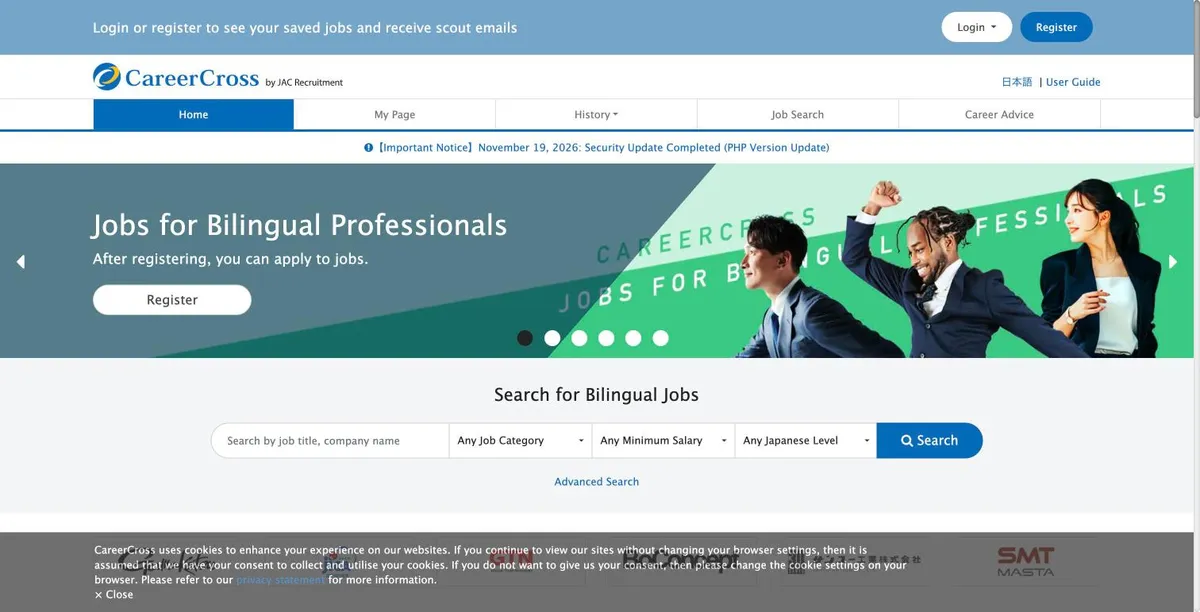
CareerCross: bilingual hiring in Japan since 2000
Most Japanese job boards assume a Japanese-speaking reader looking for a Japanese employer. CareerCross targets the gap: professionals who work in both Japanese and English, whether they are Japanese nationals with strong English or foreign residents with business-level Japanese. Its LinkedIn company page dates the service to December 2000, and the site marked its 25th anniversary recently. The operator named in the footer is CareerCross Co., Ltd.
The English site lists bilingual positions in Japan, mostly at international companies and the recruitment agencies that serve them, with a Japanese version alongside.
How CareerCross filters bilingual jobs
The search form has three fields that matter. Job category covers about two dozen groups, including executives and corporate planning, accounting and finance, HR, legal, logistics and supply chain, banking, IT and web, electronics and semiconductors, automotive engineering, pharma and healthcare, hospitality, education, and translation and interpretation. Minimum annual salary runs in steps of 0.5 million yen at the lower end and wider steps higher up. The third filter is the one that defines the site: required Japanese level, with options for none, basic, daily conversation, business, fluent and native. A section lists overseas jobs, and themed collections cover remote roles at global companies or casual dress codes.
Who CareerCross serves
Candidates are bilingual professionals already in Japan or planning to move there: finance and accounting staff, IT engineers, sales and marketing managers, executive assistants, supply chain specialists and translators. Employers are foreign-affiliated firms, Japanese companies with international business, and recruitment agencies; listings are split between direct-hire companies and recruiter companies. The Kanto region around Tokyo is the main hub, with separate pages for Kansai and Tokai.
CareerCross costs for employers and candidates
Candidates pay nothing to register, apply, receive scout mails or set up job alerts. For employers, CareerCross offers both monthly plans and contingency (success fee) services, but it does not publish prices as of late 2026; companies request a quote through the contact form on the CareerCross employer page.
Why bilingual professionals search on CareerCross
The Japanese level filter saves a lot of time. A foreign engineer with conversational Japanese can hide jobs that require native-level keigo, and a Japanese accountant can look for roles where English is a daily tool. Salary is shown in yen per year, which makes offers easier to compare. A registered profile can receive scout mails from employers and agencies, so passive candidates still hear about relevant roles. The career advice section and the journal publish articles on job hunting and working in Japan.
Why employers hire bilingual talent through CareerCross
The pitch is access to candidates that general Japanese portals rarely surface: Japanese speakers with business English and foreign IT engineers with Japanese skills. Employers can search the candidate database and send scout mails themselves, or let CareerCross recruitment specialists run the scouting when the HR team is short-staffed. Featured company pages give room for employer branding.
CareerCross features in brief
- Japanese language level filter on every search.
- Scout mail system for both direct sourcing and outsourced scouting.
- Separate listings for direct employers and recruitment agencies.
- A salary guide, which the site notes is temporarily disabled at the time of writing.
Should bilingual candidates use CareerCross?
CareerCross does one thing well: matching bilingual talent with international employers in Japan. The language filter and yen salary bands are exactly what this audience needs. Drawbacks: many listings come from agencies rather than employers, pricing is on request, and the site design feels dated next to newer platforms. We recommend it to foreign residents with real Japanese skills, Japanese professionals with strong English, and multinationals hiring in Tokyo. More options are in our Asian job board directory.